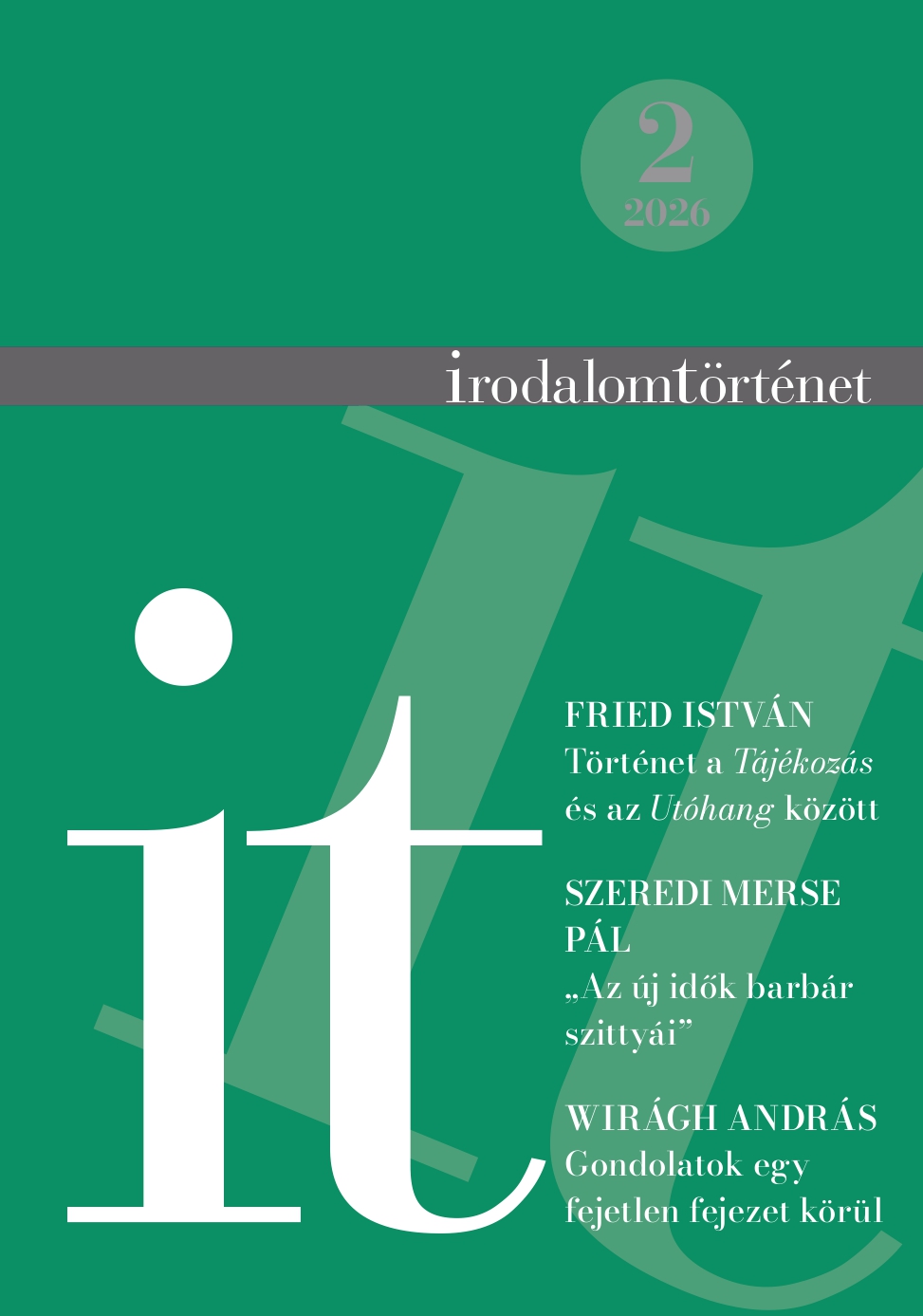
Történet a Tájékozás és az Utóhang között
Jókai Mór Börtön virága regényének újraolvasása
DOI: 10.62615/It.2026.2.01
PDF
Az írónak ebben az utolsó életévében keletkezett, a fáradtság jeleit kétségkívül magán viselő alkotásában még a szokásosnál is sűrűbben bukkannak fel a korábbi Jókai-művekre utaló reminiszcenciák.” A kétségkívül-t a magam részéről óvatosan megkérdőjelezném, akárcsak a „szokásosnál is sűrűbben”-t. Mindazonáltal nem tagadom, hogy nem jogosulatlan a feltételezés; a külső jellemzők (az író életkora) mellette szólnak, de egy szorosabb olvasás módosíthat a sajtó alá rendező állításán. Ezért hasznosnak bizonyulhat, ha a regényből kinyert adatokkal olvasóként szembesülünk, elmerülünk a regény szövegében, miközben a Jókai-életmű idevonatkoztatható, ideirányítható motívumainak a műben betöltött szerepét, netán a motívum transzformálódását, végső fokon egy újragondolt történet során kibontott, nem pusztán a felületi egyezésekre szorítkozó szövegi megvalósulását kíséreljük meg az elemzés tárgyává tenni. Ilyképpen finomítható a sajtó alá rendezőnek a Jókai-szakirodalommal teljes mértékben egyeztetett véleménye, mely eleve kevésbé értékeli a kései Jókai-műveket, mint azokat, amelyeket Jókai az 1860-as, 1870-es esztendőkben írt. /// In this work, written in the final year of the author’s life and undoubtedly bearing signs of fatigue, reminiscences referring to earlier works by Jókai appear even more frequently than usual.” For my part, I would cautiously question both the use of the word “undoubtedly” in this comment made by the editor of a 1912 edition of his last novel, and the claim that such reminiscences occur “even more frequently than usual.” While I agree that there is some foundation to this assumption – the external circumstances, most notably the author’s age, lend it some support – a closer reading may lead to a modification of this assessment. It may therefore prove useful to confront the data extracted from the novel with the reader’s own experience. While immersing ourselves in the text, we can examine the role played within the work by those motifs from Jókai’s oeuvre that can be related or directed toward it, and perhaps also investigate the transformation of such motifs. Ultimately, the aim is to make the object of analysis the textual realization of a reworked story, a story that has unfolded through the course of the narrative and extends beyond mere surface correspondences. In so doing, it will become possible to refine the view held by Jókai’s editor, a view that is fully consistent with Jókai scholarship – that Jókai’s later works are of less value than those he wrote in the 1860s and 1870s.
„Az új idők barbár szittyái”: Kassák Lajos Ma című folyóiratának új szerzői köre a bécsi emigrációban (1923–1925)
DOI: 10.62615/It.2026.2.02
PDF
Tanulmányom szisztematikus, elsősorban archívumi forrásokra épülő áttekintést nyújt arról a jórészt pályakezdő szerzőkből álló körről, amely 1923 és 1925 között a Kassák Lajos által Bécsben szerkesztett Ma folyóirat köré szerveződött. 1922 őszére a Ma 1918–1919 körül összeállt irodalmi és képzőművészeti csoportjának valamennyi vezető tagja – Barta Sándor, Újvári Erzsi, Mácza János, Bortnyik Sándor, Uitz Béla – elhagyta a lapot, így Kassáknak új munkatársakat kellett maga köré gyűjtenie. 1923 tavaszától egy nála mintegy egy generációval fiatalabb, magát „maistának” nevező csoport lépett a helyükre. Írásom elkülöníti a mozgalom „szatellitjeihez” tartozó, külső munkatársként közreműködő szerzőket (Reiter Róbert, Déry Tibor, Josef Kalmer) és a Kassákhoz tartósan csatlakozó fiatalokat (Nádass József, Glauber Henrik, Tamás Aladár, Hans Suschny, Vajda Sándor, Erg Ágoston), akiknek pályáját, motivációit és stratégiáit egyenként tárgyalja. A hangsúlyt nem a Mában megjelent versek poétikai elemzésére, hanem a kultúrtörténeti kontextus rekonstrukciójára helyezem: a bécsi emigráció mindennapjaira, a szatmári és máramarosszigeti diákkapcsolatokra, a Bécs és Budapest közötti transzferekre, valamint a Ma nemzetközi kapcsolathálójának (Der Sturm, Contimporanul) működésére. Külön tárgyalom az 1924 című antológiát és a 365 című budapesti röpiratot, valamint József Attila sikertelen csatlakozási kísérletét Kassák köréhez. /// This article offers a systematic, largely archive-based survey of the circle of mostly debuting writers that formed around Ma (Today), the avant-garde periodical edited by Lajos Kassák in Vienna, between 1923 and 1925. By the autumn of 1922 every leading member of the literary and artistic group that had gathered around Ma in 1918–1919 – Sándor Barta, Erzsi Újvári, János Mácza, Sándor Bortnyik and Béla Uitz – had left the journal, obliging Kassák to recruit new contributors. From the spring of 1923 their place was taken by a group roughly a generation younger than the editor, who called themselves “Maists”. The study distinguishes between the “satellites” of the movement, who contributed as external collaborators (Róbert Reiter, Tibor Déry, Josef Kalmer), and the younger writers who attached themselves to Kassák for good (József Nádass, Henrik Glauber, Aladár Tamás, Hans Suschny, Sándor Vajda, Ágoston Erg), whose careers, motivations and strategies are examined individually. Rather than analysing the poetics of the verse printed in Ma, the article reconstructs its cultural-historical context: everyday life in Viennese exile, the student connections from Szatmár and Máramarossziget, the transfers between Vienna and Budapest, and the workings of Ma’s international network (Der Sturm, Contimporanul). Separate attention is given to the anthology 1924, to the Budapest pamphlet 365, and to Attila József’s unsuccessful attempt to join Kassák’s circle.
Gondolatok egy fejetlen fejezet körül
Krúdy Gyula: A vörös postakocsi
DOI: 10.62615/It.2026.2.03
PDF
Krúdy Gyula a regény első, 1913-as közlése és 1928 között többször is apró módosításokat hajtott végre A vörös postakocsi szövegén. Több javítása is a regény fontos intertextusához, Puskin Anyeginjéhez kapcsolódott. Az orosz verses regény olvasástapasztalata többféle szinten jelentkezik a regényben, de legszorosabban az egyik főhős, Rezeda Kázmér szerepjátszásához kapcsolódik. Tanulmányomban elsősorban a karakter írói alteregóként való felfogását kívánom árnyalni, rámutatva, hogy A vörös postakocsi paratextusainak változásai egy feltételes szerzőhöz köthetők. Az értelmezés gyújtópontjában a szöveg kilencedik fejezete áll, amelyet alcím helyett egy mottó vezet fel. Ez a rész, amely egyúttal egy narratív ellipszisként is olvasható, fontos szöveghelyeket tartalmaz mind a feltételes szerző, mind a narrátor identitását illetően. Bár az itt említett életrajzi események visszavezethetők Krúdy Gyulához, a torzítások révén – a szerző több szövegére jellemző – „álönéletrajzi” jelleg megrajzolásához nyújtanak fogódzókat. /// Between 1913 and 1928, Gyula Krúdy made some small changes to the text of The Crimson Coach. The corrections were connected with the important intertext of the novel, Onegin. The memories of the Onegin-reading appeared in the novel in many ways, especially in the roleplay of one of the main characters, Kázmér Rezeda. In my paper I argue that the changes to the paratexts of The Crimson Coach can be linked to a hypothetical author. The focus of the interpretation is the ninth chapter of the novel, which is introduced by a motto instead of a title. This segment can be interpreted as a narrative ellipsis, which comprises significant fragments about the empirical author and the hypothetical author. Despite the fact that the biographical events referenced herein can be traced back to Gyula Krúdy, it is important to note that they contain distortions. However, these distortions can assist in the identification of the pseudo-autobiographic character that appears in numerous Krúdy-texts.
A növényi növekedés és az ihlet poétikai kapcsolata Babits Mihály költészetében
DOI: 10.62615/It.2026.2.04
PDF
Babits Mihály a költő „lelkét” határozza meg az ihlet forrásaként, amely magához hasonló formába rendezi a vers építőelemeit. Ennek ellenére a rendezőelv mintázata mégsem vezethető vissza a költő biografikus énjére: az alkotó által felhasznált versegységeket Babits statikus anyagként fogja fel, amely az ihlet szervező dinamikájában léphet a növény növekedéséhez hasonló folyamatos mozgásba. A versben rögzített költői lélekfogalom Babits felfogásában már inkább a lírai én nyitottsága felől értelmezhető, amelyhez hozzájárul Wilhelm Dilthey ihletdefiníciójának hatása, Babits általi továbbgondolása, valamint Henri Bergson által körüljárt életlendület és a költői ihlet összekapcsolása. Babits ihletfelfogásában megjelenő biológiai és alkotói folyamatok párhuzamba állítása, a növényi növekedés és a költői kifejezés processzusai a versekben is érintkeznek. Ennek legerősebb példái a mag és a csíra képi megjelenése, amely meghatározza A lírikus epilógja, a Recitativ és A gazda bekeríti házát poétikai felépítését és nyelvszemléletét, mintha a nyelvi forma a zártság ellenére magában foglalná az ihlet kiterjeszthető dinamikáját, amely folyamatos feszültségben áll a determinált fogalmisággal. /// Mihály Babits identifies the poet s soul as being the source of inspiration, this soul arranging the building blocks of the poem into a form similar to itself. The organising principle’s pattern cannot, however, be traced back to the poet s biographical self: Babits regards the poetic units used by the artist as static material which, within the organizing dynamics of inspiration, can enter into a continuous movement like the growth of a plant. In Babits s conception, the poetic concept of the soul recorded in the poem can be interpreted more in terms of the openness of the speaker, an idea influenced by Wilhelm Dilthey s definition of inspiration and Babits s further reflection on it, as well as Henri Bergson s connection between and poetic inspiration. The parallel Babits draws between the biological and the creative processes – the processes of plant growth and poetic expression – is reflected in his poems. The strongest examples of this are the images of the seed and the sprout, which define the poetic structure and linguistic approach of A lírikus epilógja, Recitativ, and A gazda bekeríti házát, as if the linguistic form, despite its closed nature, contains within itself the extendable dynamic of inspiration, something which is in constant tension with deterministic conceptuality.
Az élő emlékmű
Kalavszky Zsófia: A totális Puskin. Populáris műfajok a Puskin-kultuszban, 1837–1937
DOI: 10.62615/It.2026.2.05
PDF
Kapcsolat
Magyar Irodalom- és Kultúratudományi Intézet
Eötvös Loránd Tudományegyetem Bölcsészettudományi Kar
1088 Budapest, Múzeum krt. 4/A épület
Tel.: (1) 4855-200/5113, 5366
www.btk.elte.hu
www.racio.hu
eisemann.gyorgy@btk.elte.hu
vincze.richard.it@gmail.com
Magyar Irodalomtörténeti Társaság, 2024 - Minden jog fenntartva ©
Támogatók


Magyar Kultúráért Alapítvány
A honlap fejlesztését az Eötvös Loránd Tudományegyetem Folyóiratfejlesztési Alapja támogatta.